Natural Stone in China - the Global Powerhouse Behind Modern Hardscaping
China is a “hot market” for natural stone for one simple reason: it’s not just a quarrying country—it’s a global stone manufacturing engine. China sits at the intersection of mass domestic demand, industrial-scale processing, and global distribution, making it one of the most influential players in how stone is priced, processed, finished, and shipped worldwide.
This guide is written for serious buyers and specifiers (hardscaping, landscape, commercial, and residential) who want to understand the history, structure, product reality, and trade flows behind “Stone from China.”

Table of contents
- 1) How China became a stone superpower
- 2) The real size and structure of the industry
- 3) China’s stone geography: where the industry actually lives
- 4) Stone types China produces and sells
- 5) Finished goods: what China exports best
- 6) Key end-markets: who buys Chinese stone and why
- 7) Largest players and “clusters” that matter
- 8) Growth drivers, constraints, and the near-future
- 9) What to watch when sourcing for hardscaping
1) How China became a stone superpower
China’s rise in natural stone tracks the country’s broader industrial expansion:
- Mass domestic building and infrastructure demand created scale.
- Industrial clustering concentrated processing, tooling, logistics, and skilled labor in specific regions.
- China didn’t only quarry domestically—it became a global hub for importing blocks, processing them efficiently, and supplying finished stone into international markets.
Two events symbolically represent that maturity:
- The rise of Shuitou (Nan’an, Fujian) as a trading + processing epicenter (a place known for processing and distribution at a scale that effectively “sets the pace” for many categories of stone).
- The global prominence of the Xiamen International Stone Fair, which is one of the most important global gatherings for stone materials, tooling, and buyers. The official show site highlights the scale (thousands of brands and buyers from many countries).

2) The real size and structure of the industry
China’s stone industry is enormous—and importantly, it’s industrialized.
From the China Stone Material Association (reported via industry coverage), 2023 data includes:
- 820 million m² of natural stone slabs produced (down year-over-year), including granite and marble production breakdowns.
- 3,526 “above-scale” enterprises (a common China statistical cutoff), with 758 quarrying and 2,768 processing companies.
- Total turnover cited at RMB 274.91 billion (with a decline vs the prior year), which still signals a very large base.
A key takeaway for buyers:
- China’s advantage isn’t just “access to stone.” It’s the ability to turn blocks into finished products at scale: calibrated pavers, tiles, coping, cut-to-size, steps, kerbs, cladding, and project packages—often with short lead times when factories are available.
3) China’s stone geography: where the industry actually lives
China’s stone ecosystem is best understood by clusters, not just provinces.
Fujian: Xiamen + Nan’an (Shuitou) = trading + processing gravity
Shuitou (near Xiamen) is frequently described as a major national and international stone distribution center, with huge volumes moving through nearby ports. One industry report describes the Shuitou center as turning over RMB 20 billion annually and shipping via Xiamen and Quanzhou ports.
This matters because Fujian acts like a “stone exchange”:
- imported blocks arrive
- materials are processed
- finished goods are consolidated and shipped
Guangdong: Yunfu = “Stone Capital of China” (processing + engineered + natural mix)
Yunfu is widely referred to as a major stone processing hub—often discussed as a “stone capital” region with deep expertise in manufacturing and distribution.
National association footprint
China also has a mature national industry structure with the China Stone Material Association as a central body publishing industry updates and standards-related work.
4) Stone types China produces and sells
China’s offering is broad. For hardscaping and building stone, these are the categories that matter most:
Granite
- The workhorse material for pavers, setts/cobbles, steps, kerbs, coping, wall caps, and exterior cladding.
- Often supplied in flamed, bush-hammered, sandblasted, or leathered finishes for slip resistance.
Marble
- More common indoors (floors, walls, bathrooms, feature stone).
- Also used outdoors in some climates, but it’s more sensitive to acids and weathering than many granites.
Limestone
- Frequently used for walling, coping, and “soft-modern” architectural palettes.
- Performance depends heavily on density, absorption, and finish.
Slate / Quartzite
- Quartzite and slate are popular for textured cladding, flagstone, stepping stones, and certain architectural uses (with quartzite generally being tougher).
Basalt
- A major hardscaping favorite globally for dark modern outdoor palettes, pavers, and setts.
The real commercial strength: China doesn’t just sell “stone types.” It sells repeatable product programs (thickness, calibration, finishing, packaging, container optimization).

5) Finished goods: what China exports best
For hardscaping and building supply, the practical categories where China often competes well are:
Outdoor hardscape products
- Pavers (calibrated or sawn, various finishes)
- Setts/cobbles (split-face, sawn, tumbled)
- Curbing/kerbstone
- Steps and risers
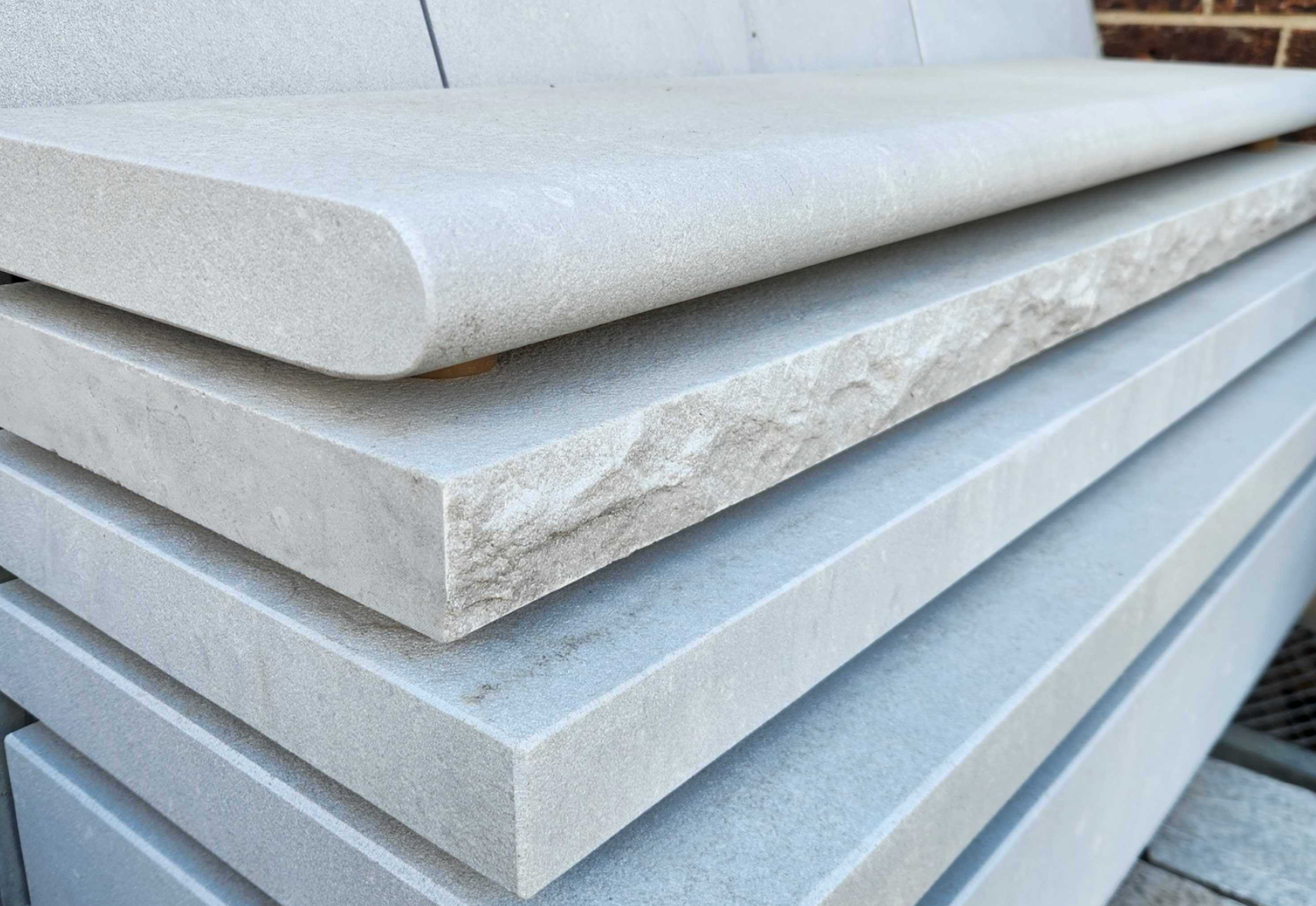
- Pool coping and bullnose programs
- Wall caps and pier caps
Dimensional / architectural stone
- Cut-to-size façade packages
- Stair treads, thresholds, sills
- Project-based shop drawings (for larger commercial supply chains)
Monument and memorial categories
Some larger integrated companies explicitly list memorial/monument work among served markets.
6) Key end-markets: who buys Chinese stone and why
China’s stone flows into two big market buckets:
A) Domestic China demand
Even in years where export or real-estate is soft, China remains a “super-sized” demand market in scale terms (as described in industry reporting tied to CSMA commentary).
Domestic uses include:
- commercial and residential construction packages
- municipal landscaping and streetscapes
- airports, rail stations, large public works (where stone is specified for durability and prestige)
B) Export markets
Exports vary by product mix, pricing cycles, and trade conditions, but China remains a major supplier for:
- North America (hardscape products, dimensional stone, tiles)
- Europe (select categories; often more spec-driven)
- Middle East (project stone and large commercial builds)
- Asia-Pacific (steady regional demand)
Trade data shows China exports raw or roughly processed monumental/building stone under common HS headings for marble and granite categories, though much of China’s true export strength is in worked stone / finished products rather than raw blocks.
7) Largest players and clusters that matter
In China, “largest players” often mean:
- large integrated enterprises (quarries + factories + installation/project services), and
- cluster leaders (companies embedded in Shuitou/Xiamen/Yunfu ecosystems that can scale output and logistics).
Example: Xiamen Wanli Stone (illustrative of the integrated model)
Wanli is a known large player in China’s stone industry with a vertically integrated footprint (quarries, processing capacity, multi-location facilities).
Public market tracking for the company also shows scale via reported revenue figures (useful as an external validation of size).
Why clusters matter more than “brand names”
For many hardscape buyers, the real capability is the cluster:
- tooling suppliers and maintenance
- finishing lines (flaming, bush-hammer, waterjet, CNC)
- packaging + container loading know-how
- access to imported blocks and domestic material
- consistent labor + QC systems
Industry anchor events: Xiamen Stone Fair
The Xiamen show functions as a real-time pulse of:
- product trends (finishes, formats)
- supply chain movement
- machinery evolution
- buyer appetite
The official show site highlights international scale and timing for the next edition.

8) Growth drivers, constraints, and the near-future
Growth drivers
- Urban development + infrastructure continues to support stone demand (especially where durability and lifecycle cost matter).
- Manufacturing efficiency: China’s processing capacity and know-how is a durable moat.
- Format standardization: global demand for repeatable paver/coping/step programs favors high-output manufacturing bases.
Constraints / friction points buyers actually feel
- Quality variance between factories (QC discipline is not uniform).
- Lot variation (especially granites and certain limestones) if sourcing from multiple quarries or switching supply mid-season.
- Logistics volatility (container rates and transit times can swing).
- Compliance expectations in some regions (documentation, testing, labeling, and traceability expectations can be strict depending on buyer type).
9) What to watch when sourcing for hardscaping
A) Performance specs that matter outdoors
- absorption / density (freeze-thaw performance)
- finish selection for slip resistance (flamed / bush-hammered / sandblasted vs polished)
- thickness and calibration tolerances
- edge treatment consistency
B) Color and blend control
C) Packaging + breakage rates
Outdoor products are heavy and brittle at corners. Good suppliers optimize:
- crate structure
- separation sheets
- strap patterns
- palletization and container blocking/bracing
D) Factory capability, not just “stone availability”
The best Chinese suppliers for hardscaping are usually the ones who can run:
- repeatable finishing lines
- consistent thickness programs
- reliable lead times
- documented QC checks
Conclusion: Why China Matters in the Global Natural Stone Market
China’s role in natural stone is bigger than “another source country.” It has become one of the most influential centers on the planet for processing capacity, product standardization, finishing capability, and global distribution. That combination is what makes China a hot market: not just because of what comes out of the ground, but because of what can be delivered—consistently—at scale.
For buyers and specifiers, the practical takeaway is simple: China is strongest when the goal is a repeatable, project-ready stone program—calibrated pavers, setts/cobbles, coping, steps, curbs, caps, and cut-to-size packages—finished to predictable textures and tolerances, then shipped efficiently through mature logistics channels.
At the same time, serious sourcing requires discipline. Quality can vary by quarry, batch, and factory, and outdoor performance depends on the right stone selection, finish, thickness, and packaging. When procurement is handled with clear specifications and tight quality control, China remains one of the world’s most dependable engines for natural stone supply—supporting everything from residential hardscapes to major public and commercial construction.
In short: China has helped industrialize natural stone. For the hardscaping and building markets, that means broader material access, faster product programs, and a supply chain capable of scaling with demand, making it a market worth understanding in detail, not a country to treat as a shortcut.